Refinancing Risk Is Quietly Replacing Interest Rate Risk for UK Property Investors

Refinancing Risk Is Quietly Replacing Interest Rate Risk for UK Property Investors
Around 1.8 million fixed-rate mortgages are expected to reset over the coming period, creating a refinancing cycle that will test affordability, liquidity and lender selectivity across the market.
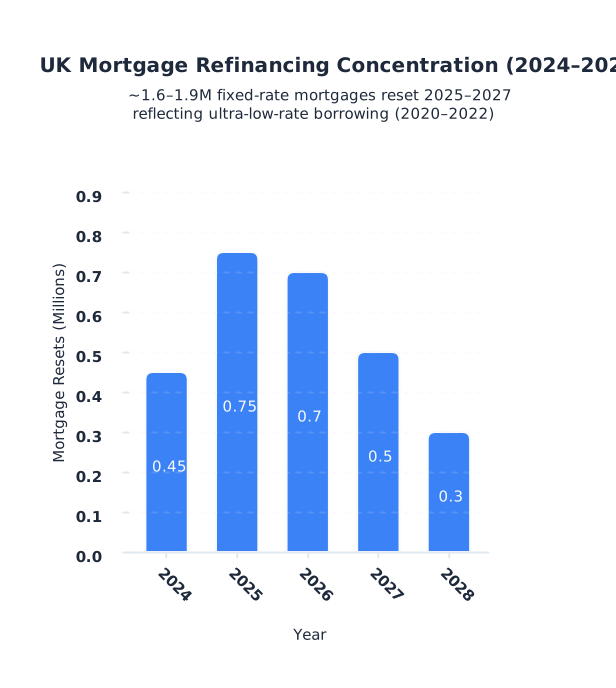
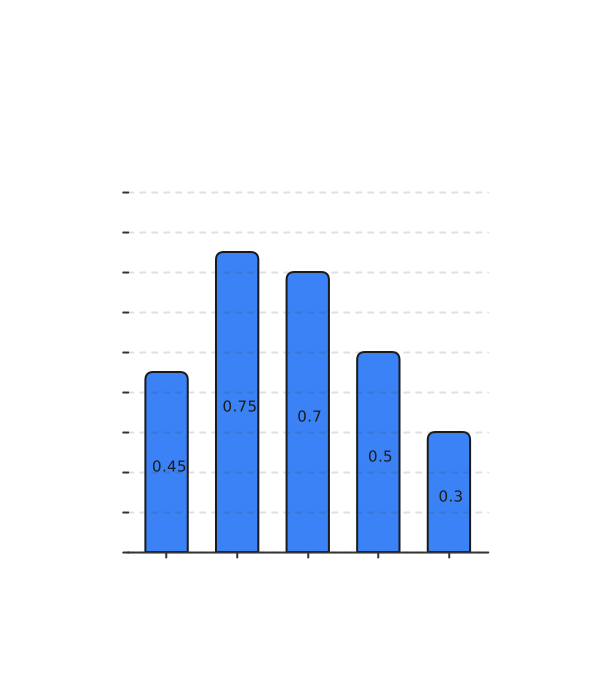
UK fixed-rate mortgage maturities (2024–2028), underscoring the scale and timing of refinance risk.
At the same time, buy-to-let lending has remained broadly flat. Capital has not disappeared — but it is becoming more selective, more cautious, and more sensitive to portfolio resilience.
For investors with strong fundamentals, this environment may create opportunity. For others, refinancing could become the moment where structural weaknesses surface rather than a routine administrative step.
Refinancing risk is the risk that portfolio financing cannot be replaced on acceptable terms at mortgage maturity. Unlike interest rate risk, which assumes financing remains available at a different price, refinancing risk questions whether financing will be available at all — or whether the terms imposed will force structural changes to how a portfolio operates.
The next 24–36 months will make this distinction concrete for a large cohort of UK landlords.
The shift is subtle. Occupancy remains strong, rents have grown, and portfolios may appear stable. Yet refinancing occurs at the intersection of leverage, liquidity and lender confidence — meaning pressure can emerge even while operational performance looks healthy.
Many investors still approach refinancing as a rate negotiation. Increasingly, lenders are treating it as a full reassessment of leverage, documentation and operational quality.
Key takeaways for investors
Why Is Refinancing Risk Changing for UK Landlords?
Three structural forces distinguish this refinancing cycle from anything investors have experienced before.
The key risk is not higher rates alone, but multiple refinancing decisions occurring before investors have rebuilt liquidity buffers.
The maturity wall. A significant proportion of buy-to-let mortgages were originated between 2020 and 2022 at fixed rates below 2.5%. With typical two- and five-year terms, these loans are maturing in a concentrated window extending through 2027. This is not a gradual cycle — it is a refinancing backlog working through the system simultaneously.
Refinancing at structurally higher rates. The shift from sub-2% to 4–5% product rates produces borrowing capacity reductions of 10–25% for highly leveraged properties. Most lenders apply stress rates of 1–2 percentage points above the product rate, pushing many rental incomes below required coverage ratios. Many investors underestimate the DSCR shock created by product maturity — the gap between what was affordable at origination and what is affordable now.
Lender behaviour has shifted. Underwriting has moved from asset-centric (assessing each property independently) to borrower-centric (assessing total portfolio exposure). Lenders apply aggregate stress tests, demand fuller documentation, and scrutinise operational compliance. Many investors assess refinancing risk at the property level while lenders assess it at the portfolio level.
What this means: Investors cannot evaluate refinancing readiness property-by-property — it requires a portfolio-level view of leverage, coverage, and liquidity.
What Portfolio Characteristics Increase Refinancing Vulnerability?
The most common misjudgements are not financial errors — they are framing errors. Investors apply assumptions that were accurate under previous refinancing conditions but no longer hold.
Rate anchoring bias
The mistake: assuming current rates are temporary and refinancing can wait for better terms. Investors who delay refinancing in expectation of rate reductions risk reverting to standard variable rates — typically 1.5–3 percentage points above fixed products. Even short SVR periods materially erode returns and weaken the affordability position for subsequent applications. Higher refinance rates reduce optionality even when portfolios remain profitable.
Underestimating refinance sequencing
The mistake: treating each mortgage maturity as an isolated event rather than a sequence. Where multiple properties mature within a short window, capital requirements, documentation demands and lender capacity constraints compound. A portfolio that can absorb one capital injection may not absorb three simultaneously. Maturity sequencing — the order and clustering of refinancing events — is a portfolio risk factor that most investors do not model.
Over-reliance on portfolio averages
The mistake: using average yield or average LTV to assess refinancing resilience. Lenders do not refinance averages — they refinance individual assets against portfolio-level exposure. A portfolio with a healthy average yield may contain specific properties that fail stress testing, and weakness in those assets can constrain terms across the portfolio. Portfolio averages mask the assets most likely to create refinancing friction.
Liquidity versus profitability confusion
The mistake: equating positive cash flow with refinancing readiness. A property can be cash-flow positive and still fail to refinance if its rental coverage falls below lender stress thresholds, or if its valuation has drifted into a higher LTV band. The refinancing event may force structural decisions rather than simple product replacement — capital injections, disposals, or acceptance of materially worse terms.
What this means: Refinancing preparation requires stress testing individual assets against current lender criteria, not reviewing portfolio summaries.
How Can Investors Prepare for Clustered Mortgage Maturities?
The window for preparation is finite, and the advantage of early action compounds. Refinancing risk is increasingly driven by maturity timing rather than interest rate direction. Investors who act now retain strategic choices; those who wait face progressively narrower options.
Selective credit conditions tend to reward prepared investors and amplify pressure on highly leveraged portfolios.
Refinancing planning. Begin lender discussions 6–9 months before maturity. Model current rental coverage against stressed rates and updated valuations. Identify properties where coverage is marginal before lenders do.
Restructuring decisions. Determine which assets are least viable on a forward-looking basis — not just current yield, but refinancing eligibility, compliance cost trajectory and capital expenditure requirements. Pre-emptive disposal at market value is materially better than forced disposal under deadline pressure.
Incorporation and structure review. Limited company structures offer mortgage interest deductibility, but lender underwriting of SPV portfolios incorporates director guarantees and aggregate exposure. Structure does not eliminate refinancing risk — it changes its form.
Lender optionality. Diversify lender relationships before you need them. Investors dependent on a single lender face concentration risk if that lender tightens criteria or restricts product availability in their segment.
What this means: The decisions made in the next 12 months — around timing, structure, and disposal — will determine refinancing outcomes more than rate movements will.
The Full Picture: Modelling, Scenarios, and Decision Frameworks
This blog frames the structural shift. The implications run deeper — into specific portfolio scenarios, escalation pathways when refinancing constraints emerge, and a readiness framework for systematic preparation.
Frequently Asked Questions
What is refinancing risk and how does it differ from interest rate risk?
Refinancing risk is the risk that portfolio financing cannot be replaced on acceptable terms at mortgage maturity. Interest rate risk assumes financing remains available at different prices. Refinancing risk questions whether financing will be available at all — or whether terms will force capital injections, asset disposals, or structural portfolio changes.
Why is refinancing risk changing for UK landlords?
Three forces are converging: a concentrated maturity wall from 2020–2022 originations, a structural rate reset from sub-2% to 4–5%, and a shift in lender behaviour toward portfolio-level underwriting. Together, these create refinancing conditions materially different from any prior cycle.
What portfolio characteristics increase refinancing vulnerability?
Key vulnerability factors include: high leverage (75%+ LTV at origination), clustered maturity dates, geographic concentration in single local authority areas, thin cash buffers, reliance on portfolio averages rather than asset-level stress testing, and limited lender diversification. See our full analysis for detailed portfolio exposure mapping.
How can investors prepare for clustered mortgage maturities?
Begin refinancing discussions 6–9 months before maturity. Model affordability under current stress rates. Identify marginal assets before lenders do. Pre-position capital for potential injections. Diversify lender relationships. Review our mortgage options guide for available product types.
What factors do lenders prioritise during buy-to-let refinance assessment?
Lenders increasingly assess: aggregate portfolio debt service coverage, compliance documentation completeness (gas safety, EICRs, EPCs, licensing), valuation resilience and LTV positioning, borrower-level income verification, and regulatory exposure including possession certainty under the Renters' Rights Act.
Will this cause a market disruption?
Not uniformly. Professional operators with strong cash flow, conservative leverage, and well-maintained assets are likely to retain access to finance. However, refinancing outcomes will diverge materially between portfolio structures. The cycle represents portfolio differentiation rather than systemic instability.
Stay Updated
Subscribe to our weekly briefings for curated property news and insights
Further Reading
- Spring Statement 2026: What Changed (and What Didn't) for UK Property Investors
- The Investment Mistakes That Don't Appear Until It's Too Late
- UK Property Is Entering the Execution Risk Era — What Investors Should Pay Attention To Now
- Budget 2025: What It Means for UK Property Investors & Landlords
- This Week in UK Property: Ground Rent Reform Moves Closer, While Investors Reprice Risk
- Heading Into 2026: What UK Property Investors Should Actually Prepare For
- Post-Budget UK Property Market Reality Check: Rates, Rents and Risks for 2026
- What Property Investors Should Pay Attention To This Week (Dec 12)
- Budget 2025: Tougher Taxes, Smarter Investors — Why I'm Still Bullish on UK Property