UK Buy-to-Let Refinancing Wave: The Structural Risk Investors Are Underestimating

UK Buy-to-Let Refinancing Wave: The Structural Risk Investors Are Underestimating
The next risk for UK landlords isn't interest rates — it's timing. A large cohort of buy-to-let mortgages written during ultra-cheap borrowing is approaching maturity simultaneously, forcing investors to refinance in a lending environment that has fundamentally changed.
For some portfolios, refinancing will be routine. For others, it will be the first time underlying leverage, documentation quality and liquidity buffers are truly tested. The distinction between these outcomes will not be determined at the point of application — it will be determined by what investors do in the months beforehand.
Estimates suggest 1.6–1.8 million UK fixed-rate mortgages will reset between 2025 and 2027, with a meaningful share linked to borrowing originated during the ultra-low interest rate period. Within buy-to-let specifically, lender commentary indicates a substantial portion of leveraged landlord borrowing will refinance within a compressed window rather than gradually over time.
Refinancing risk is shifting from a rate problem to a portfolio resilience test.
What makes this cycle different from previous refinancing periods is the convergence of three pressures: a concentrated maturity window, a structural affordability reset, and a regulatory environment that has materially changed since the original loans were written. Each of these alone would tighten refinancing conditions. Together, they create a sorting mechanism that will separate resilient portfolios from those that were reliant on favourable conditions to remain viable.
Key takeaways for property investors
How Large Is the Refinancing Maturity Wall?
How large is the refinancing cohort?
The refinancing cycle is not evenly distributed. Origination data shows borrowing between 2019 and 2022 dominates upcoming maturities, creating a rolling but concentrated refinancing wall.
A significant proportion of UK buy-to-let mortgages were originated or refinanced between 2020 and 2022, when fixed rates below 2.5% were widely available. With typical two- and five-year fixed terms, this creates a refinancing concentration extending from late 2024 through 2027 — a window that is now well underway.
Industry lending data indicates that buy-to-let remortgage activity peaked during 2021, and a substantial share of those loans were written at high LTV bands of 70–75%. Many borrowers prioritised payment stability over amortisation, meaning balances remain largely unchanged at maturity. The practical implication is that a meaningful cohort of landlords will refinance with similar leverage but materially worse affordability metrics. This is not a gradual cycle — it is a refinancing backlog working through the system.
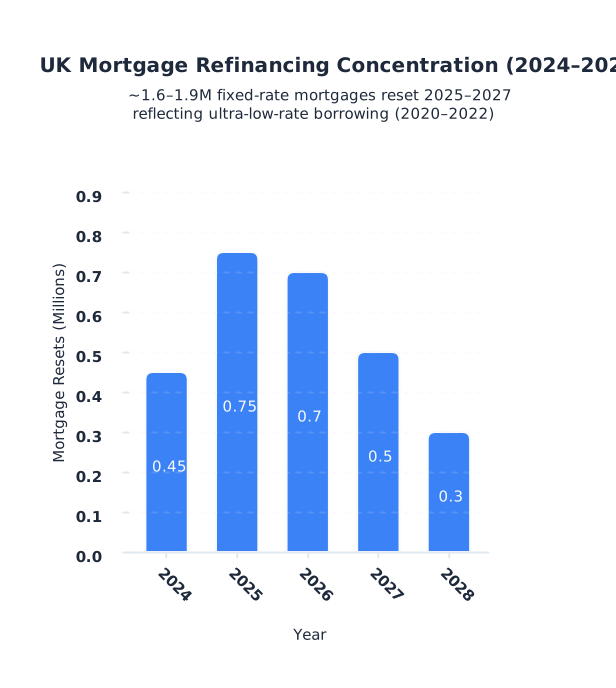
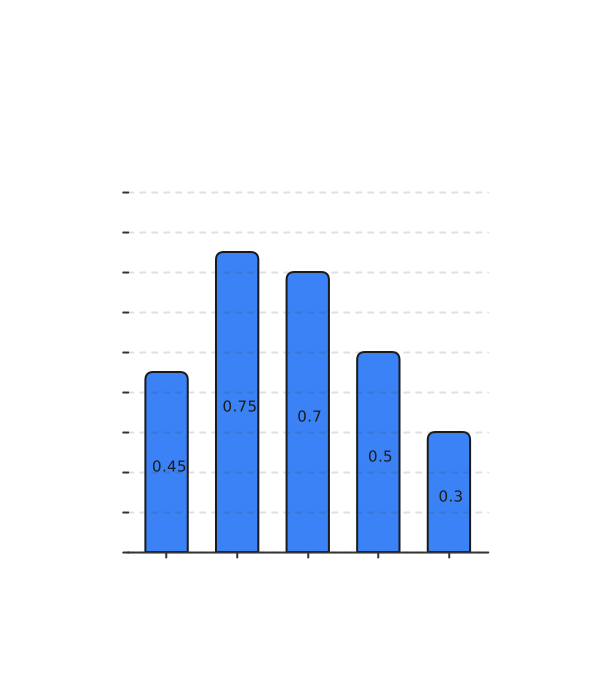
Projected UK fixed-rate mortgage maturities by year (2024–2028), highlighting the concentrated refinancing window that underpins refinancing risk.
The clustering effect matters beyond individual outcomes. When a significant proportion of borrowers approach lenders within the same period, the dynamics of product availability, processing capacity and competitive pricing shift. Investors refinancing within the peak window will encounter a less accommodating environment than those whose maturities fall outside it. Early engagement — ideally six to nine months before maturity — becomes a practical advantage in securing favourable terms before pipeline congestion narrows the available options.
The affordability reset magnitude
The shift from sub-2% borrowing to current product rates of 5–6% produces a structural reduction in borrowing capacity. Most buy-to-let lenders apply a stress rate — typically the product rate plus a margin of 1 to 2 percentage points, or a fixed floor rate, whichever is higher. When the underlying rate has more than doubled, the stress rate moves into territory where many rental incomes no longer provide the required coverage ratio, often set at 125% to 145% of the stressed mortgage payment.
A large share of buy-to-let borrowing originated during ultra-low rates is refinancing into materially tighter underwriting conditions. Across the market, this is producing borrowing capacity reductions in the range of 10–25% for highly leveraged properties. Rental growth has partially offset the effect in stronger markets, but rarely eliminates the gap entirely. Lenders are increasingly requiring top-slicing or background income verification to maintain leverage — mechanisms that were uncommon during the low-rate period. For portfolio investors whose economics were modelled on 2019–2022 cost assumptions, the gap between expected and available borrowing may be significant enough to require portfolio-level adjustment rather than a simple product switch.
Valuation sensitivity and LTV drift
The affordability reset is compounded by valuation sensitivity. Modest price changes can materially affect refinancing outcomes for leveraged portfolios. Where price growth has stalled or reversed, loan-to-value ratios increase despite consistent mortgage balances, restricting product availability or increasing borrowing costs.
A valuation decline of just 5% can move a property financed at 75% LTV close to or beyond key lender pricing thresholds, materially increasing refinancing cost or limiting product availability. In regions where price growth has been flat or negative since 2022, this scenario is not hypothetical. Investors refinancing in such markets face a choice between injecting cash to restore their LTV position or accepting materially worse terms that further compress already thinning margins.
What this means: The affordability reset is not a temporary pricing inconvenience — it is a structural reduction in borrowing capacity that requires portfolio-level adjustment.
What Are the Early Signs of Refinancing Friction?
Product availability and lender selectivity
Several observable signals already indicate tightening conditions. Investors have experienced rapid product repricing during rate volatility periods, shorter product reservation windows, and increased lender selectivity for portfolio landlords. This does not signal credit withdrawal from the sector, but it does signal reduced tolerance for marginal affordability cases. Lenders are, in effect, re-underwriting not just the loan but the borrower's operational model.
Several lenders have also tightened their treatment of portfolio-level income, applying aggregate stress tests that consider the borrower's total exposure rather than assessing each property in isolation. Where underwriting was previously asset-centric — focused on the individual property's rental income and value — it is increasingly borrower-centric, incorporating total debt service obligations, vacancy exposure across properties, and capacity to absorb shocks in one part of the portfolio without defaulting elsewhere. Lenders are increasingly re-underwriting landlords, not just properties. The practical implication is that portfolio health must be managed as a whole, not property by property.
Stress testing that previously assumed effective rates near 3–4% now frequently operates in the 7–9% range, reducing borrowing capacity even where rental income has grown.
A further signal has emerged as at April 2026: a borrower-level tactical shift toward 2-year fixes, driven by expectations of near-term rate cuts. With average 2-year BTL fixed rates sustained at 5.90%, this represents a deliberate trade — accepting current pricing pressure in exchange for optionality at the next renewal. The strategic implications interact directly with the stress-test dynamics above: 2-year fixes attract the most restrictive stress testing, meaning this tactical bet simultaneously increases the affordability hurdle at the next refinancing event.
Processing capacity and timing risk
Broker and lender feedback increasingly highlights longer underwriting timelines for portfolio cases, additional documentation requests, and heightened valuation scrutiny in slower regional markets. Where refinancing is initiated late, timing risk alone will push investors onto standard variable rates even where refinancing is ultimately achievable — a costly outcome that erodes returns during the transition period.
How Does Regulatory Change Affect Refinancing Terms?
The removal of Section 21 and reliance on statutory possession grounds introduces timing uncertainty that lenders must now price. From a lender's perspective, the ability to recover possession underpins the security value of the loan. Where possession timelines become longer and less predictable under the Renters' Rights Act 2025, the effective recovery value of collateral decreases. This influences terms: higher LTV thresholds, wider stress margins and more conservative income multiples are mechanisms through which lenders price in possession uncertainty.
Simultaneously, selective licensing expansion, property condition enforcement and civil penalties create financial uncertainty that feeds into affordability modelling. A civil penalty issued against a landlord signals to a lender that management standards fall below acceptable thresholds, potentially triggering enhanced due diligence or adverse terms on future applications. The reputational and financial dimensions of compliance failure are converging in ways that directly affect refinancing outcomes.
Licensing, compliance and maintenance cost increases can reduce net rental surplus by hundreds of pounds per property annually, eroding debt-service coverage even without interest rate changes. The cumulative effect of higher property standards, mandatory licensing fees, ombudsman membership costs and increased insurance premiums creates a structural uplift in operating costs that erodes the rental surplus available to service debt. Investors who modelled their portfolio economics on cost assumptions from 2019–2022 may find that current operating reality produces materially different coverage ratios at refinancing. Even modest increases in operating expenditure can reduce interest coverage margins below lender thresholds, turning what appears to be a viable asset into one that fails affordability testing.
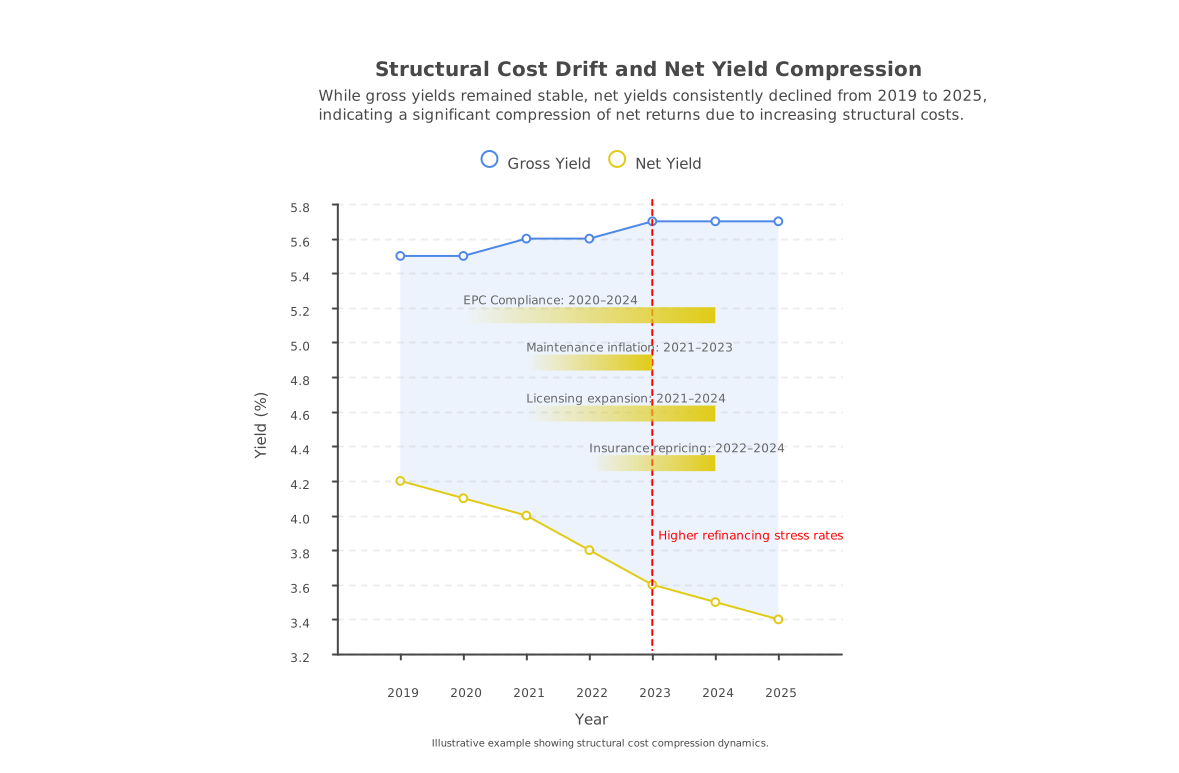
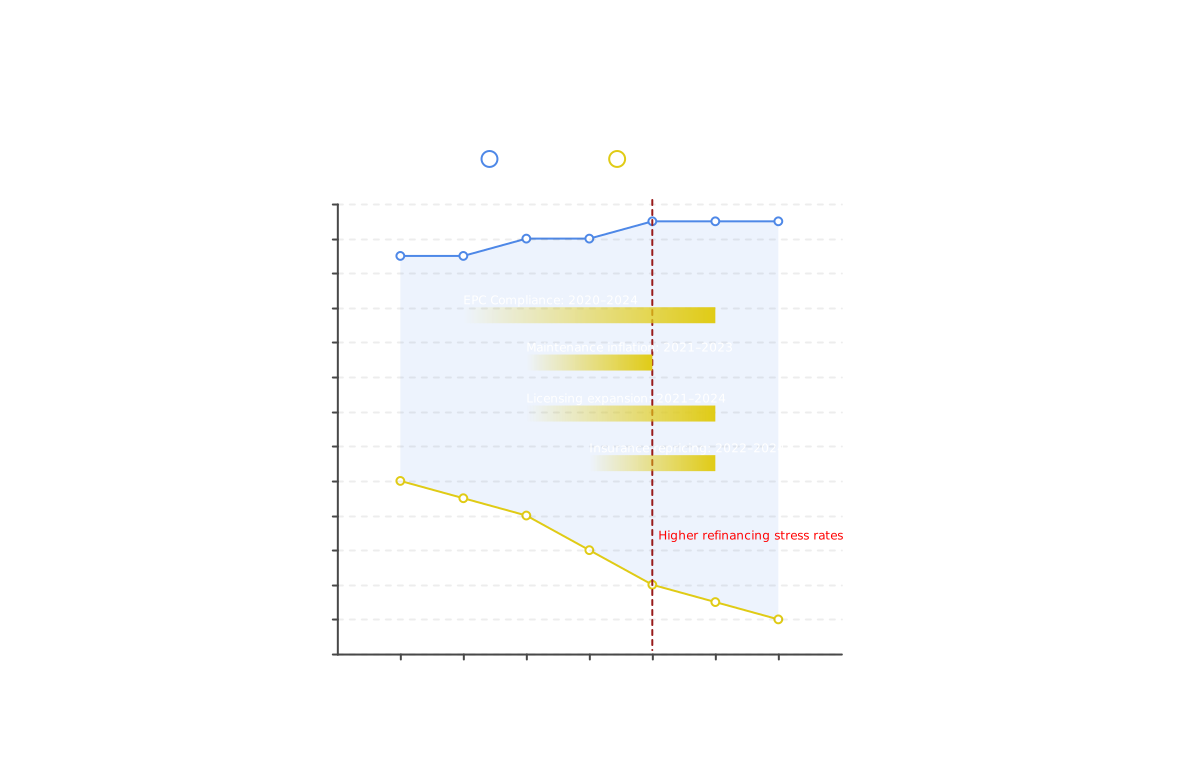
Illustration of how refinancing cost increases can erode yield, compress net investor returns, and shift risk dynamics.
For investors holding property through limited company structures, the regulatory dynamic is different but not necessarily less demanding. Corporate borrowers benefit from full mortgage interest deductibility, but lender underwriting of SPV portfolios increasingly incorporates director guarantees, company-level compliance records and aggregate exposure assessments. The perception that corporate structures insulate investors from regulatory refinancing risk is only partially correct.
The regulatory and financial dimensions of refinancing risk are converging. Investors who approach refinancing as a purely financial exercise — focused on rate and LTV — may be unprepared for the operational scrutiny now embedded in the process. This represents a broader shift toward execution risk across the sector.
What this means: Compliance gaps are no longer just regulatory risks — they are refinancing risks that directly affect terms, timelines, and approval outcomes.
What Portfolio Characteristics Increase Refinancing Vulnerability?
High-leverage portfolios face the greatest immediate pressure. Investors who financed at 75% LTV or above during the low-rate period are exposed to both rate resets and valuation softness simultaneously. Where investors also extracted equity through remortgaging during the growth period, effective leverage may be higher than the original acquisition LTV suggests. Refinancing constraints at this level may require capital injections or restructuring — decisions that are difficult to execute under time pressure.
Low-margin assets are vulnerable where rents are constrained by local affordability ceilings. Such properties may remain tenanted and income-producing but fail to meet lender coverage requirements, creating a mismatch between operational viability and financing eligibility. Understanding the true cost structure of these assets — not just headline yield — is critical for identifying refinancing risk before it materialises.
Geographically concentrated portfolios face amplified exposure to localised regulatory pressures. An investor with multiple properties in a single local authority area that introduces selective licensing faces a simultaneous cost increase across the portfolio that a diversified investor would not. Lenders assessing such portfolios may apply additional risk weightings to reflect the concentration of regulatory exposure.
Short-term strategy investors reliant on the BRRR model or value-add cycles face timing risk where processing delays intersect with refinancing deadlines. Where refinancing stalls, the entire capital recycling strategy stalls with it — trapping equity and disrupting acquisition pipelines.
The maturity concentration means refinancing constraints are likely to occur simultaneously across multiple assets within leveraged portfolios rather than sequentially, increasing liquidity and decision pressure.
What this means: Portfolio vulnerability is driven by specific structural characteristics — not broad market conditions. Investors should assess their own exposure against these categories.
What Happens When Refinancing Constraints Emerge?
Refinancing difficulties rarely appear suddenly. They typically follow a predictable escalation that is important to understand because each stage narrows the available responses.
The most common first signal is an affordability shortfall discovered at application — the gap between available borrowing and the outstanding balance becomes visible. In some cases the shortfall is modest and manageable; in others, particularly for highly leveraged properties in flat or declining markets, the gap may represent tens of thousands of pounds per property. The investor then considers a capital injection to bridge the gap, which requires available liquidity that may not have been planned for.
Investors who fail to secure a new product before maturity will revert to their lender's standard variable rate. SVR pricing is typically 1.5 to 3 percentage points above prevailing fixed rates, and for buy-to-let mortgages with no early repayment charge, lenders have limited incentive to offer competitive retention terms. Even a short period on SVR will materially erode annual returns and further weaken the affordability position when a new application is eventually submitted.
Where liquidity is insufficient, weaker assets are identified for disposal — but selling under time pressure close to a refinancing deadline typically produces worse outcomes than planned disposals executed with sufficient lead time to achieve market value. Our Exit Strategy and Disposal Timing analysis covers the full decision framework for sequencing disposals, including the cost anatomy, CGT timing, and possession constraints that determine whether a forced exit destroys value or preserves it. Identifying which assets are least viable on a forward-looking basis — considering not just current yield but refinancing eligibility, compliance cost trajectory and capital expenditure requirements — allows investors to allocate disposal proceeds where they generate the greatest portfolio-level benefit.
If disposal is not viable or proceeds are insufficient, the investor may resort to temporary higher-cost finance such as bridging. Bridging rates are materially higher than term mortgage rates, and the exit strategy must be clearly defined before entry. Investors using bridging to cover a temporary refinancing gap should ensure the underlying issue — whether affordability, valuation or compliance — will be resolved within the bridge term, rather than simply deferring the problem at additional cost. In the most constrained scenarios, the cumulative effect will trigger forced strategic restructuring: portfolio reduction, leverage compression, or acceptance of materially worse lending terms that permanently reduce returns.
The risk is not refinancing difficulty in isolation, but multiple refinancing events occurring before investors have rebuilt liquidity. Early identification of potential affordability gaps — modelling current rental coverage against likely stress rates and updated valuations — is the single most effective intervention. Investors who discover constraints six months before maturity retain a wide range of responses. Those who discover them six weeks before maturity do not.
What this means: The refinancing event may force structural decisions rather than simple product replacement. Early scenario analysis is the highest-leverage preparation activity.
How Should Investors Assess Refinancing Readiness?
Investors approaching refinancing must be able to answer the following with confidence:
Timing and engagement. Do you know the exact maturity date of every mortgage in your portfolio? Have you begun refinancing discussions at least six months in advance? Early engagement with appropriate mortgage products expands available options and provides time to address issues.
Affordability resilience. Does your portfolio maintain comfortable rental coverage under current stressed rates? Could you inject capital without forced asset sales if borrowing capacity falls short?
Valuation sensitivity. Do you understand how a 5–10% valuation decline would affect your LTV bands? Have you identified properties close to lender threshold levels?
Operational strength. Is all compliance documentation current and accessible — gas safety, EICR, EPC, licensing? Are current operating cost assumptions reflected in your financial modelling?
Liquidity and contingency. Do you hold a liquidity buffer covering refinancing costs and potential capital injections? Have you pre-identified assets that could be disposed of without destabilising the portfolio?
Outlook — A Sorting Mechanism, Not a Market Shock
The forthcoming refinancing cycle is unlikely to produce uniform market distress. As broader market analysis suggests, refinancing pressure is one of several structural forces reshaping the investment landscape. Outcomes will vary widely based on leverage, management quality and liquidity. Well-prepared investors will experience limited disruption, while others will encounter strategic pressure that forces difficult decisions.
Liquidity — not interest rates — may become the binding constraint for leveraged investors. The refinancing wave represents a period of portfolio differentiation rather than systemic instability. The window for preparation is finite, and the advantage of early action compounds. Investors who address potential constraints now retain the widest range of strategic choices. Those who defer may find their options progressively narrowed as maturity dates approach.
Refinancing risk has evolved from a rate-driven concern into a multidimensional assessment of financial resilience and operational quality. The structural nature of this cycle — driven by maturity clustering, regulatory change and lender behaviour shifts rather than a single macroeconomic variable — means that preparation must be equally structural. The refinancing cycle will differentiate resilient portfolios from those dependent on favourable conditions. Balance sheet management, compliance rigour, portfolio-level planning and early lender engagement are the mechanisms through which investors can convert refinancing risk into a manageable operational process rather than an existential portfolio challenge.
For a concise framing of why this shift matters and the common misjudgements investors make, see our companion piece: Refinancing Risk Is Quietly Replacing Interest Rate Risk.
Investor implication summary
Frequently Asked Questions
When will the UK buy-to-let refinancing wave peak?
The refinancing concentration extends from late 2024 through 2027, with peak activity expected in 2025-2026 as the bulk of 2020-2022 mortgages mature. Early engagement (6-9 months before maturity) is recommended to secure terms before pipeline congestion.
How much will borrowing capacity reduce for highly leveraged properties?
Across the market, borrowing capacity reductions range from 10–25% for highly leveraged properties due to stress rate changes from sub-2% to 5–6% rates. The exact impact depends on rental coverage ratios, LTV bands, and regional market conditions. Use our cost benchmarks for realistic modelling.
What documentation do lenders now require for buy-to-let refinancing?
Lenders increasingly require gas safety certificates, electrical installation condition reports (EICRs), energy performance certificates (EPCs), and licensing compliance as standard. Documentation gaps can delay applications, trigger additional conditions, or result in declines. Operational quality has become a refinancing factor alongside financial metrics.
How does the Renters' Rights Act 2025 affect refinancing?
The Act introduces possession uncertainty that lenders price into terms through higher LTV thresholds, wider stress margins, and more conservative income multiples. Compliance costs and regulatory exposure are increasingly embedded in lender affordability modelling. See our risk profile analysis for detailed implications.
Should I delay refinancing until rates fall further?
Waiting for rate improvements carries significant risks. Standard variable rates (SVR) are typically 1.5–3 percentage points above fixed rates, and timing constraints may force acceptance of worse terms. While some borrowers are pivoting to 2-year fixes in anticipation of rate cuts, this approach re-exposes the portfolio to refinancing risk at the next maturity. Early engagement preserves options while rate speculation may eliminate them entirely.
How can I prepare for refinancing 6-9 months in advance?
Start by auditing compliance documentation, modelling affordability under current stress rates, and identifying properties near LTV thresholds. Begin lender conversations to understand product availability and requirements. Consider pre-emptive capital injection or partial repayment to improve terms. Review our mortgage options guide for product types.
What happens if I can't refinance my buy-to-let property?
The escalation typically follows: affordability shortfall discovery → capital injection requirement → asset disposal consideration → temporary bridging finance → forced restructuring. Each stage narrows available options. Early identification of constraints preserves strategic choices, while delayed discovery may force portfolio reduction or acceptance of permanently worse terms.
Stay Updated
Subscribe to our weekly briefings for curated property news and insights